
Edge AI + LLM Agents in 2026: Building Automation That Stays Useful, Safe, and Governable
LLM agents are moving from demos to daily operations, and the shift is changing what “automation” means in industrial and field environments. It’s no longer just dashboards and alerts—it’s systems that propose actions, execute workflows, and carry context across tasks.
At the same time, the industry is relearning an old lesson: the quality of outcomes depends on the quality of inputs—requirements, telemetry, prompts, and the questions teams ask when something breaks. In applied IoT automation, that discipline is the difference between a reliable system and an expensive science project.
1) From “asking questions” to engineering feedback loops
In production IoT, failures rarely announce themselves cleanly. A pump “looks fine” until a transient vibration spike shows up at 2
a.m. A vision model “works” until dust, glare, or a firmware update shifts the data distribution. When teams escalate issues with vague problem statements, they force everyone else to reverse-engineer the context.The practical upgrade is to treat troubleshooting as an engineering artifact, not a chat message. That mindset scales across Edge AI deployments, predictive maintenance programs, and security operations.
A high-signal question (or incident report) typically includes: what changed, how to reproduce, what the device observed, what the cloud pipeline observed, and what has already been tried. This is not bureaucracy—it’s latency reduction. In systems where minutes of downtime can translate to lost production, crop stress, or safety exposure, “clear inputs” are an ROI lever.
In Edge AI specifically, the key is to preserve “altitude”: describe the operational goal (detect cavitation early), then the constraint (no reliable backhaul), then the symptom (false positives after recalibration). That framing prevents teams from optimizing the wrong layer—model, sensor, network, or workflow.
2) A workable architecture: Edge AI, cloud computing, RAG, and LLM agents
The most robust pattern emerging in 2026 is a split-brain system:
Edge AI handles fast, local decisions under real-world constraints (latency, bandwidth, uptime). Cloud computing handles fleet learning, cross-site analytics, and governance. LLM agents orchestrate tasks across tools—but only when they’re grounded in authoritative data via RAG (retrieval-augmented generation).
The point is not to “replace” classical automation. It’s to connect it. A well-designed agent becomes a coordinator: it can interpret a maintenance runbook, query the latest sensor windows, retrieve the correct SOP revision, and open a ticket with the right evidence—without inventing facts.
Design choices that tend to make or break production deployments:
- Define what must stay on-device: safety interlocks, latency-critical inference, and resilience functions belong to Edge AI.
- Use RAG as a control surface: the agent should answer from approved docs, telemetry summaries, and structured events—not from general memory.
- Constrain actions with explicit permissions: “read-only” modes for analysis, scoped “write” actions for a narrow set of systems.
- Treat prompts and tools like code: version them, test them, and roll them out gradually across the IoT ecosystem.
- Measure drift at three layers: sensors (calibration), models (performance), and workflows (agent/tool failures).
This architecture also reduces cost and risk. Edge inference avoids unnecessary backhaul, while cloud retraining and evaluation can be scheduled and audited. Meanwhile, RAG limits free-form generation by binding responses to the same sources engineers and auditors trust.
Design rule for agent “memory”: If an agent can remember across contexts, it can also leak across contexts. Compartmentalize memory by project, purpose, and sensitivity, and require provenance (source + timestamp + scope) before any memory can influence an operational decision.
3) Privacy, safety, and governance: the new operational constraints
Two trends are converging: agents are becoming more personal and proactive, and regulators and customers are becoming less tolerant of opaque data handling.
“Memory” features and personalization can improve usability—especially for repetitive workflows—but they also create a single, high-value repository of behavioral data. In industrial and critical environments, that repository can accidentally mix operational telemetry, credentials, supplier details, and human conversations. Once mixed, it becomes harder to explain why the system acted—and harder to limit who can access what.
Age checks in consumer AI highlight the same technical tension: confirming user status without building an invasive identity honeypot. In enterprise IoT automation, the parallel is workforce and contractor access—verifying who can trigger actions without copying sensitive identity data into every tool.
Governance isn’t theoretical. When generative systems are used to summarize tips, reports, or investigations, speed improves—but so does the risk of bias amplification, over-trust in summaries, and untraceable decision chains. In industrial settings, the equivalent is an agent that “helpfully” compresses alarms into a short brief while omitting the one signal an expert would have prioritized.
For technical leaders, the playbook is to make governance an engineering requirement:
- Separate data domains (operations, HR, health/safety, security) by default.
- Log agent actions and tool calls as first-class telemetry.
- Require human confirmation for high-impact steps (shutdowns, purchases, credential changes).
- Keep models and workflows auditable, including what documents RAG retrieved.
This is where Edge AI can help: local processing reduces the amount of raw data centralized in the first place, lowering breach impact while improving responsiveness.
4) Strategic implications for industry, agrotech, energy, and cybersecurity
In energy and industrial markets, messaging may shift with politics, but constraints remain: rising demand, aging infrastructure, and increasing operational complexity. Data centers and electrification pressures turn grid reliability into a business dependency, not just a utility concern.
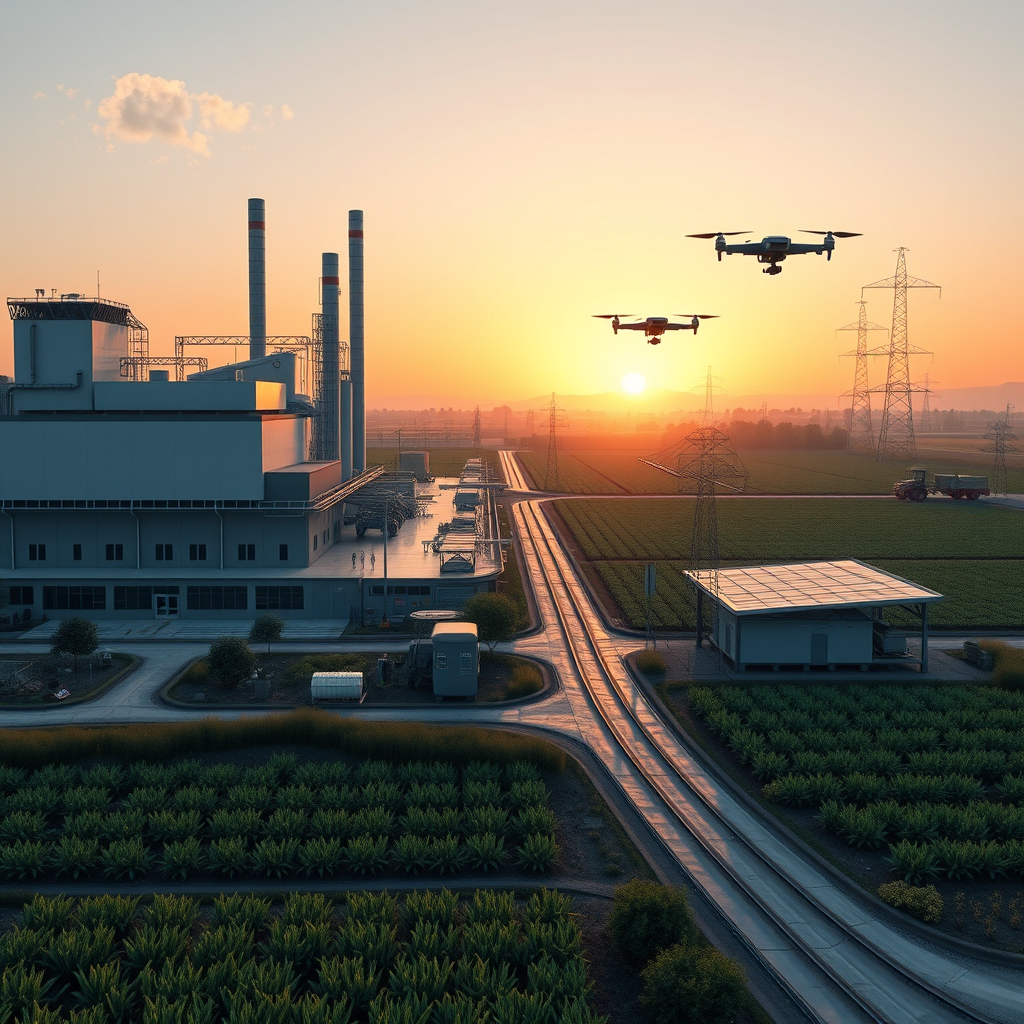
For agrotech, autonomous irrigation systems are a direct response to variability—weather swings, water constraints, labor shortages. Edge AI enables decisions at the field level (valves, pumps, fertigation) even when connectivity is inconsistent. Cloud analytics then provides benchmarking across farms and seasons.
For cybersecurity, agentic workflows introduce a new class of risk: automation that can act. The answer isn’t to ban agents; it’s to scope them. Use agents to triage, correlate, and propose—then gate execution behind policy, identity, and segmented access.
The competitive advantage in 2026 is not “having an AI.” It’s operating an IoT automation stack that stays reliable under drift, stays cost-effective under scale, and stays governable under scrutiny.
Learn more about our applied IoT + AI work

Metadata:
Title: Edge AI + LLM Agents for IoT Automation in 2025 | Angelo Labs
Description: A practical blueprint for combining Edge AI, LLM agents, RAG, and cloud computing to deliver governable IoT automation—without compromising privacy, safety, or operational reliability.
Keywords: Edge AI, IoT automation, LLM agents, RAG, predictive maintenance, privacy by design